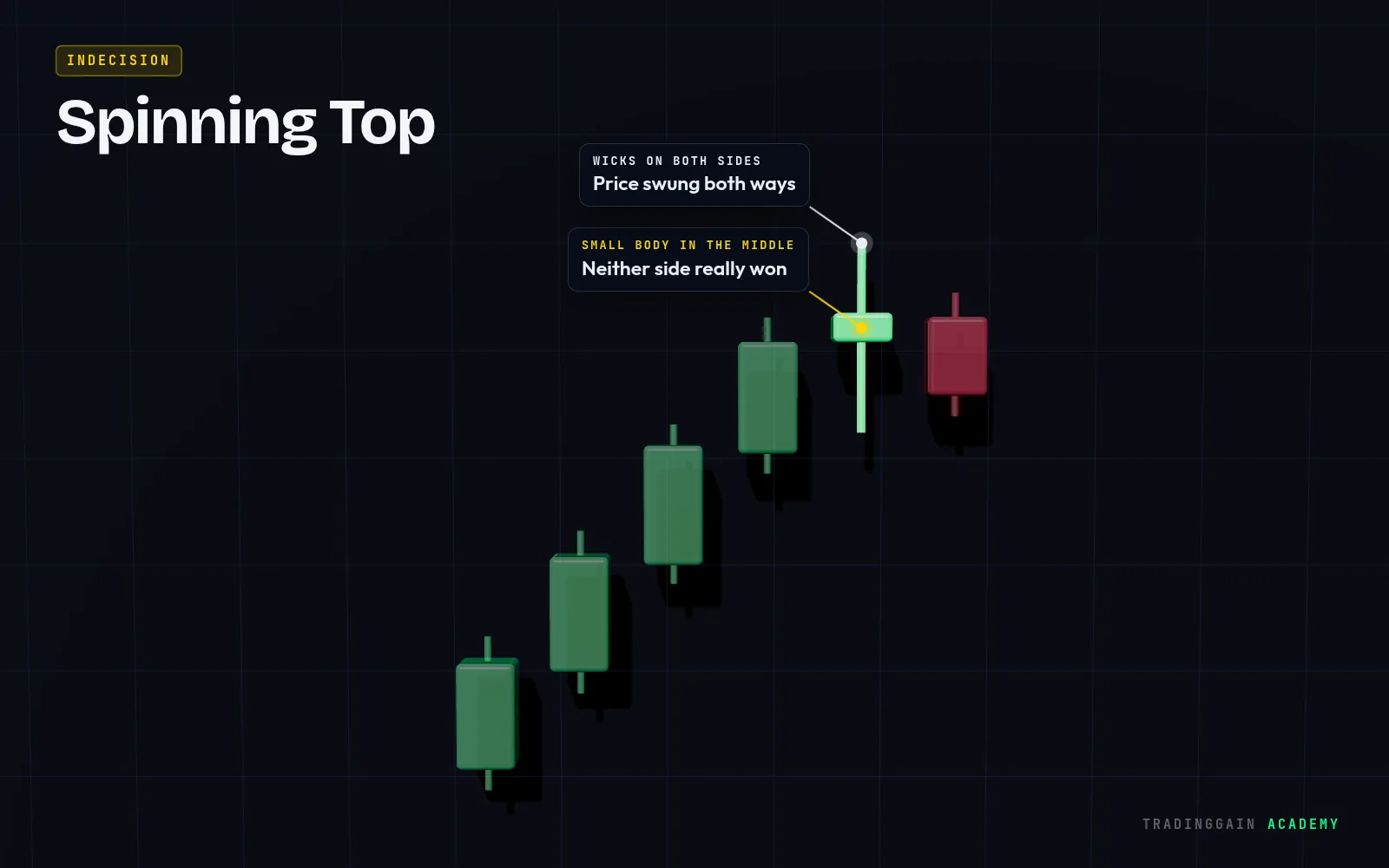
How to spot a Spinning Top
- Small body near the middle of the range
- Upper and lower wicks of roughly similar length
- The body is small, but not as tiny as a doji
What the Spinning Top tells you
Buyers and sellers both pushed, but the close ended up close to the open. After a strong trend, a spinning top can show that momentum is fading. Inside a range, it usually means very little.
How traders use it
- Treat it as a pause, not a signal
- Wait for the next candle to break its high or low
- Combine it with a support or resistance level before acting
Common mistakes
- Trading every spinning top
- Confusing it with a strong reversal candle
- Ignoring the trend around it
 See it on a real chart · EP 01Candlestick Patterns for BeginnersWatch the free lesson →
Questions about the Spinning Top
Is a spinning top bullish or bearish?
It is neutral. It shows indecision, and the following candles decide the direction.
Spinning top vs doji?
Both show indecision. A doji has almost no body, while a spinning top has a small but visible body.
For education only, not financial advice. The chart is an illustration of the pattern, not real market data. No pattern works every time; always use a stop-loss.