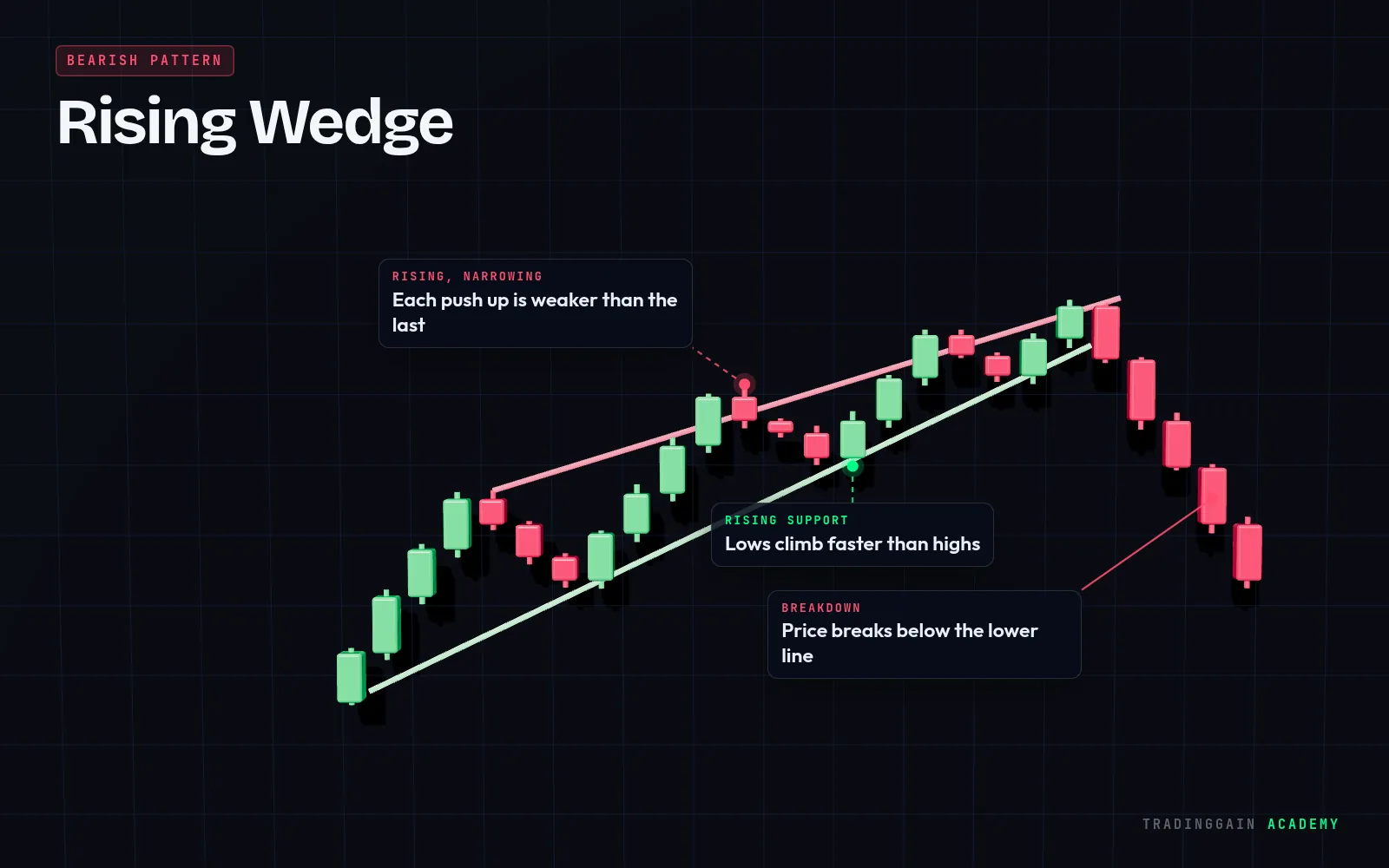
How to spot a Rising Wedge
- Two rising trendlines that converge
- Highs and lows both rise, but the move gets weaker
- Often appears at the end of an uptrend or as a bounce in a downtrend
- Breaks down through the lower line
What the Rising Wedge tells you
Price is still rising, but with less and less strength. When the lower line breaks, the buyers who were holding up the climb give way.
How traders use it
- Enter short on a close below the lower line
- Place the stop above the last high inside the wedge
- A common target is the start of the wedge
Common mistakes
- Shorting while price is still inside the wedge
- Confusing it with an ascending channel, where lines are parallel
- No stop-loss
 See it on a real chart · EP 03Trend and Trendlines: How to Draw ThemWatch the free lesson →
Questions about the Rising Wedge
Is a rising wedge bullish or bearish?
It is usually bearish, even though price is rising inside it, because momentum is fading.
Rising wedge vs ascending triangle?
An ascending triangle has a flat top. A rising wedge has both lines sloping up and narrowing.
For education only, not financial advice. The chart is an illustration of the pattern, not real market data. No pattern works every time; always use a stop-loss.