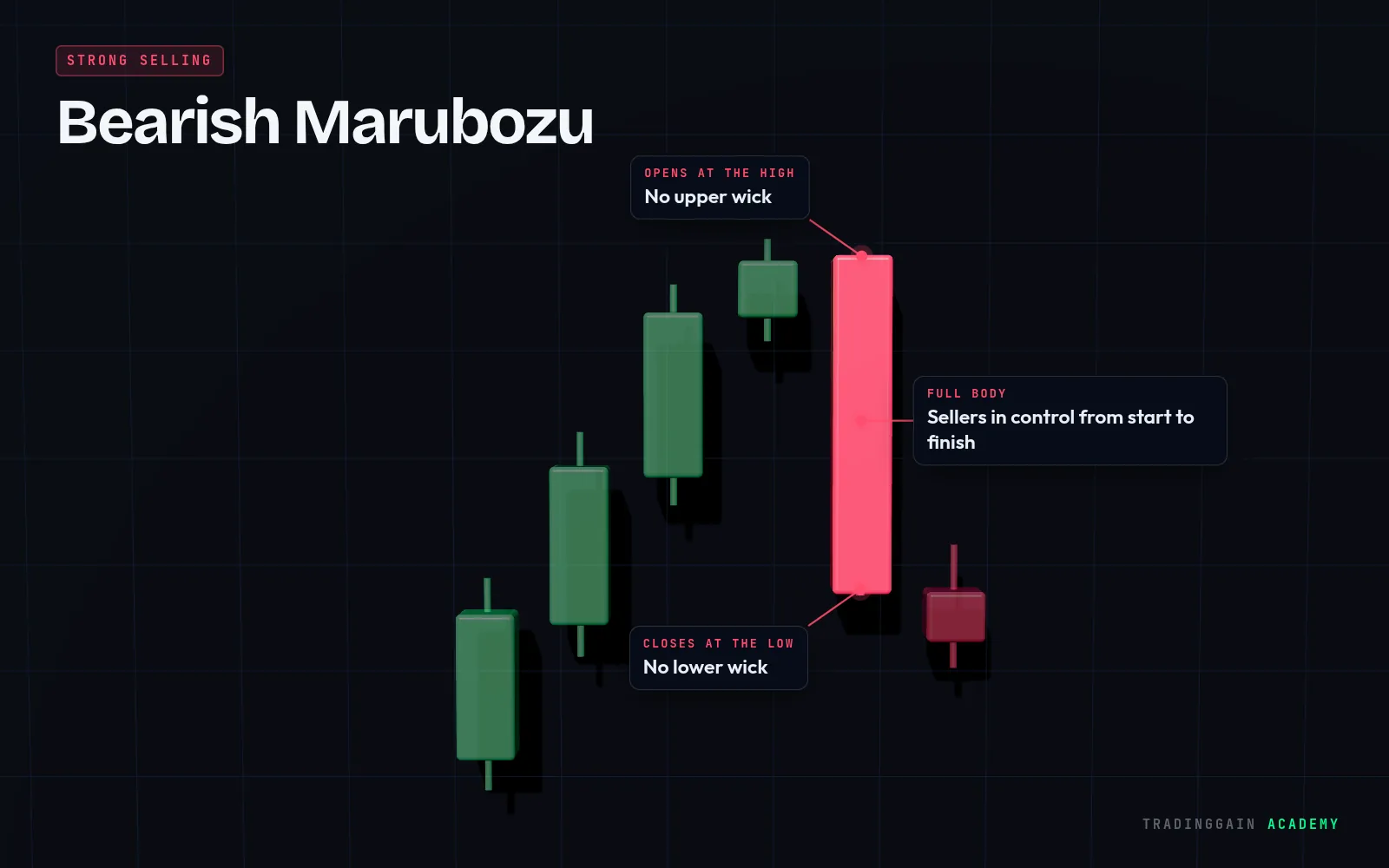
How to spot a Bearish Marubozu
- Long red body
- No upper wick and no lower wick, or very tiny ones
- Much bigger than the candles before it
What the Bearish Marubozu tells you
Sellers controlled price for the entire period. It often appears at the start of a sharp drop or when price breaks below support.
How traders use it
- Treat it as a sign of strong selling pressure
- Avoid buying straight into it
- Look for short entries on a small bounce, with the stop above the candle
Common mistakes
- Shorting at the very bottom of a huge candle
- Trying to catch the bottom right after it
- Ignoring volume and the level it broke
 See it on a real chart · EP 01Candlestick Patterns for BeginnersWatch the free lesson →
Questions about the Bearish Marubozu
What does a bearish marubozu mean?
It means sellers were in full control from the open to the close. It signals strong downward momentum.
Should I buy after a bearish marubozu?
Buying straight after it is risky, because momentum is strongly down. Wait for the market to stabilise and show a reversal pattern first.
For education only, not financial advice. The chart is an illustration of the pattern, not real market data. No pattern works every time; always use a stop-loss.